We confirm the amazing achievements of Yiddish without any negation at all of the importance of Modern Hebrew, Ladino, Zionism, secular Judaism, Jewish culture as a whole (yiddishkeit) or any other intimate, creative, and authentic Jewish entity and conviction. In addition, we are not all just Yiddishists, of the sort who are committed to Yiddish and only to Yiddish. Just the opposite. We are of various Jewish ideologies. "Whatever we are, we speak Yiddish" - Yiddish is our common property and an integral part of our anchoredness in a part of our identity, our past, and in a part of our future.--Joshua Fishman, from אַ באַגריסונג־וואָרט לכּבֿוד דעם 100סטן יובֿל פֿון דער טשערנאָוויצער שפּראַך־קאָנפֿערענץ an article in the Yiddish Forward commemorating the 100th anniversary of the Yiddish Language Conference. Translation mine.
Showing posts with label Yiddishism. Show all posts
Showing posts with label Yiddishism. Show all posts
8/31/08
Without any negation


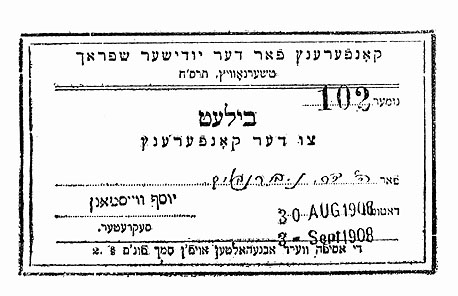
3/15/08
Cernăuţi/Чернівці/Czerniowce/Czernowitz/Tschernowitz/טשערנעוויץ
Yiddishists: fighting against inferiority since 1908.
2/18/08
Applied Nostalgia
My daughter and I had a fight last night (she's four; it happens) and we made up with me singing songs to her. The songs were in Yiddish, the language we speak at home. I was randomly singing whichever Yiddish songs happened to come into my head, and in the middle I thought: Isn't this ridiculous? The last three songs were a Bund ballad about blowing up a German ammunition convoy; a paean to Vilna; and the Partisans' Song. (I'm not usually so historical, but there you are.) It struck me, not for the first time, how unrooted my Yiddish language and culture is in my individual, quite ordinary-American-Jewish experience, and how an outside, Eastern-European-born observer might think that my use of these historically freighted songs is disrespectful, jokey, or obscene. (Some do.) What do I know of guerilla warfare, Jewish Vilna (I mean its physical bricks-and-mortar), or the routes of the Baal Shem Tov (the subject of another song)?
I used to answer "No" (a little hurt) when asked if my attachment to things Yiddish was due to nostalgia. How can I be nostalgic for something I wasn't born into? But that's precisely the point. We yearn for what we are not conditioned against. The tension of my ideological attachment to Yiddish is to be aware of the sunken past while not drifting away from the present in which Yiddish, very much extant, is quite un-Eastern European.
As for nostalgia, Jews couldn't get along without it. One of my daughter's favorite songs is Yah Ribon, whose last verse recollects the Temple. I never saw that either.
I used to answer "No" (a little hurt) when asked if my attachment to things Yiddish was due to nostalgia. How can I be nostalgic for something I wasn't born into? But that's precisely the point. We yearn for what we are not conditioned against. The tension of my ideological attachment to Yiddish is to be aware of the sunken past while not drifting away from the present in which Yiddish, very much extant, is quite un-Eastern European.
As for nostalgia, Jews couldn't get along without it. One of my daughter's favorite songs is Yah Ribon, whose last verse recollects the Temple. I never saw that either.
12/18/07
2/18/07
Should not have been a talmid-khokhem
I am trying to express my appreciation of Schaechter (as everyone called him) in a limit-yourself-to-800-words sort of way. Meanwhile, a thought from today's shiva call, where someone quoted a frum acquaintance of the deceased. "It's a pity [Dr. Schaechter] wasn't a Torah scholar," the acquaintance supposedly said, "because he was so medakdek [punctilious]."
Two possible responses: no, he shouldn't have been a Torah scholar, because then he wouldn't have been what he was. Torah scholarship is not so destitute, nor the Jewish world of intellectual endeavor so narrow, that every talent must be yeshiva-fied. We have minds aplenty and lots of problems to work on, from the nature of God to the proper number of bird sacrifices - to questions of language preservation and standardization.
In fact, Schaechter was a secular Jew. Some friends and I (they are academic Yiddishists who devote their life to the language and literature) are discussing his passing over e-mail, and one pointed out that our subject line (borekh dayen emes, "Blessed be the True Judge"), while an appropriate and natural response for some of us, is not appropriate for Schaechter. He was many things in his appreciation of the Jewish people, but religious he was not. He was a secular Yiddishist, an ideology with its own powerful advantages, blindnesses, and failings, not to be lumped into our own personal categories, no matter how much we are beholden to them.
Second is that being medakdek (הקפדה, דקדקניות) is not what I think of as necessary for a Torah scholar. Encyclopedic knowledge, certainly; exactitude, yes; but above all an inspired creativity. But creativity is a dirty word in some circles.
I am trying to express my appreciation of Schaechter (as everyone called him) in a limit-yourself-to-800-words sort of way. Meanwhile, a thought from today's shiva call, where someone quoted a frum acquaintance of the deceased. "It's a pity [Dr. Schaechter] wasn't a Torah scholar," the acquaintance supposedly said, "because he was so medakdek [punctilious]."
Two possible responses: no, he shouldn't have been a Torah scholar, because then he wouldn't have been what he was. Torah scholarship is not so destitute, nor the Jewish world of intellectual endeavor so narrow, that every talent must be yeshiva-fied. We have minds aplenty and lots of problems to work on, from the nature of God to the proper number of bird sacrifices - to questions of language preservation and standardization.
In fact, Schaechter was a secular Jew. Some friends and I (they are academic Yiddishists who devote their life to the language and literature) are discussing his passing over e-mail, and one pointed out that our subject line (borekh dayen emes, "Blessed be the True Judge"), while an appropriate and natural response for some of us, is not appropriate for Schaechter. He was many things in his appreciation of the Jewish people, but religious he was not. He was a secular Yiddishist, an ideology with its own powerful advantages, blindnesses, and failings, not to be lumped into our own personal categories, no matter how much we are beholden to them.
Second is that being medakdek (הקפדה, דקדקניות) is not what I think of as necessary for a Torah scholar. Encyclopedic knowledge, certainly; exactitude, yes; but above all an inspired creativity. But creativity is a dirty word in some circles.
Subscribe to:
Posts (Atom)


